Risk management is not about predicting the market. And it is not about avoiding volatility.
At its core, risk management is about designing a portfolio so that volatility does not force you to do something stupid.
Most large losses in practice do not come from being wrong about direction. They come from being forced to act: selling into illiquid markets, de-risking after prices have already moved, losing decision rights because leverage, redemptions, or risk limits are triggered.
At that point, the problem is no longer judgment. It is the loss of choice.
For institutional allocators, the central question is never: “Will the market go up from here?”
It is: In an adverse but plausible scenario, does this portfolio force me to act at the worst possible time?
If the answer is yes, the risk is structural, not analytical.
Good portfolios are not built to be right. They are built to remain solvent, liquid, and flexible when conditions are wrong.
In long-horizon investing, survival precedes conviction.
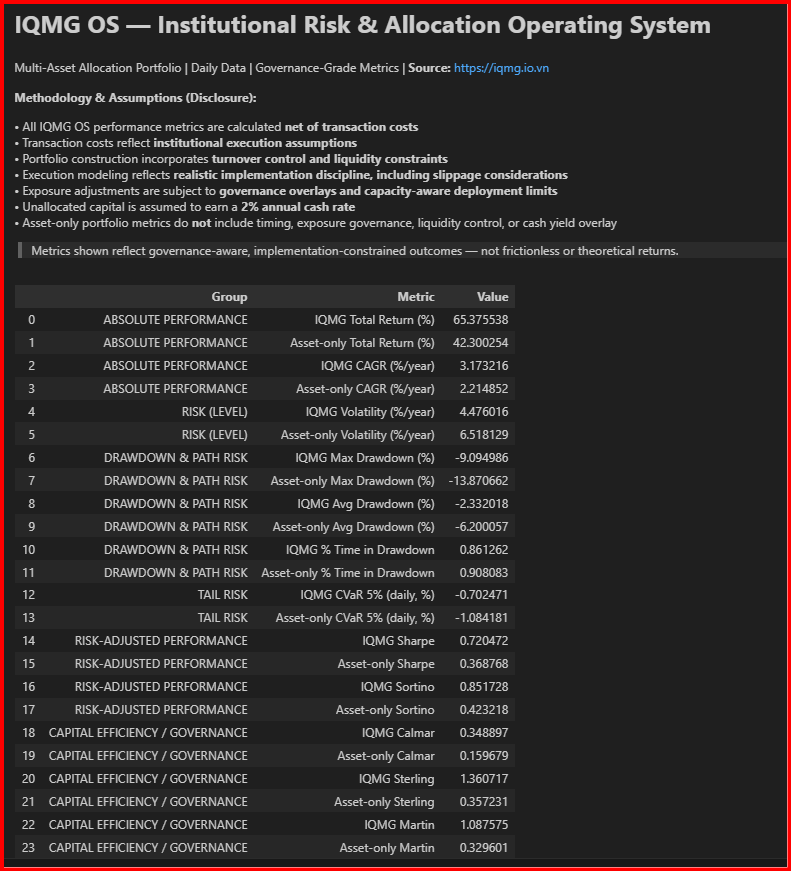
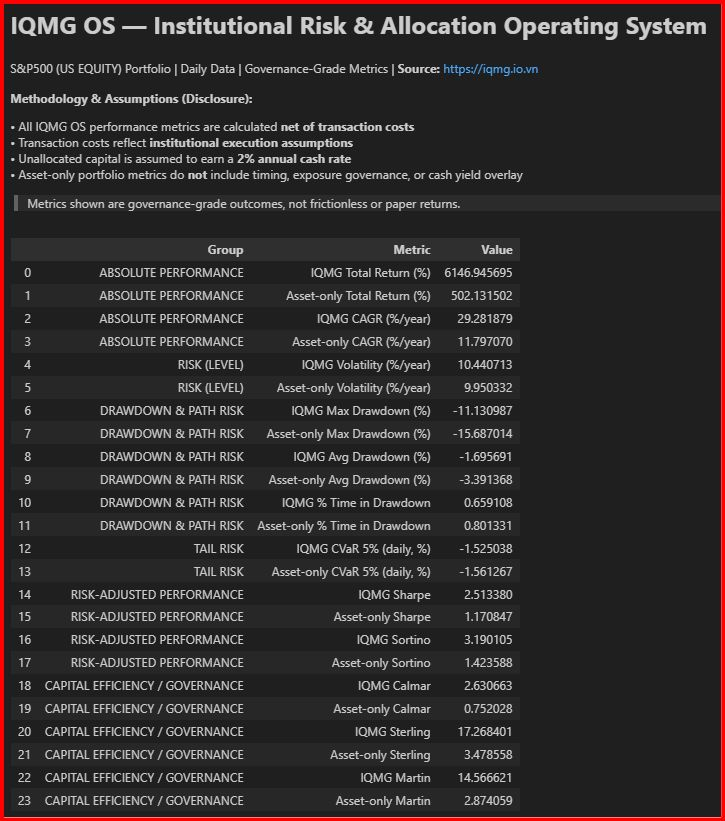
Over the past weeks, I ran multiple versions of the same systematic equity strategy on the DJ30 universe.
At first glance, some versions looked extraordinary: – Sharpe above 2.4 – Calmar above 3 – Max drawdown below -6%
On paper, they were beautiful.
But then the real question emerged: Can this survive at $1–5 billion AUM?
That question changes everything.
When you move from “a few hundred million” to “billions,” the objective shifts:
It is no longer about maximizing Sharpe. It is about maximizing survivability under scale.
Here is what becomes critical at that level: – Average daily turnover – Tail turnover (days with extreme rebalancing) – Cost amplification under stress – Liquidity concentration per name
A strategy with 7% daily turnover may look superior in backtests. But at $5bn, that is $350m traded per day.
So I intentionally moved to a lower-intensity structure: • ~2.4% average daily turnover • ~1.3 bps annual execution cost • Minimal stress amplification • Very thin cost tails
Sharpe dropped from >2.3 to ~1.8.
That trade-off is intentional.
Because at institutional scale: A robust Sharpe 1.8 that survives size is superior to a fragile Sharpe 2.5 that collapses under impact.
The uncomfortable truth is this: Most strategies are designed to look good at small size. Very few are engineered to survive billions.
When your ambition changes, your design philosophy must change.
At billion-dollar scale, you optimize for: • Liquidity governance • Turnover discipline • Impact containment • Structural robustness
Not just return metrics. Performance attracts capital. Capacity keeps it.
And if the goal is to build a flagship institutional strategy, capacity discipline must come before cosmetic Sharpe optimization.
When credit markets are structured in tiers, we often take comfort in the idea that risk is segmented and diversification will absorb shocks. That assumption only holds in normal conditions. The critical question is what happens when correlations across tiers suddenly spike toward 0.9 during a liquidity crisis. At that point, the issue is no longer pricing or fundamentals, but whether the system can continue to function.
A correlation spike is a regime shift. As correlations approach one, diversification fails and the tiered structure loses its shock-absorbing role. Senior, mezzanine, and junior tranches stop behaving independently and begin to move as a single, synchronized risk block. What adjusts in that moment is liquidity, not intrinsic value.
Tier 2 and Tier 3 are hit first not because fundamentals deteriorate, but because of their role as buffers within the system. They are more exposed to margin pressure, balance-sheet contraction, and forced selling. Prices reprice nonlinearly—driven by liquidity stress rather than expected loss—while carry that looked stable over years can be erased quickly.
From a capital preservation perspective, the focus shifts away from expected return toward survivability. How long can the portfolio function when liquidity disappears? Tiering is a tool, not a safeguard. Correlation is the switch. When it flips, Tier 2 and Tier 3 cease to be sources of carry and become transmission channels for systemic stress.Activate to view larger image,
The central issue is not the absolute level of yields, but the structure of the system in which those yields are formed. Yield curve data from 2021 to the present shows a persistent and consistent pattern: long-term term spreads such as 10Y–1Y, 10Y–2Y, and 5Y–2Y have remained largely flat or inverted. What matters is not the existence of this condition, but its persistence. This is no longer a short-lived anomaly, nor merely a cyclical reflection of growth expectations. From an observational standpoint, the yield curve has ceased to function as a signaling device and is instead operating as a structural constraint embedded within the capital allocation system.
A disciplined analysis requires separating observable facts from familiar interpretations. The data shows prolonged compression of long-term term premia, a limited widening between policy-controlled front-end rates and the long end of the curve, and forward or implied spreads that have remained low or negative for multiple years. At the same time, the data does not, on its own, imply an imminent recession, provide reliable guidance on cyclical timing, or justify tactical duration positioning. Labeling the yield curve as a recession signal in this context is therefore narrative-driven rather than data-driven, reflecting habit more than evidence.
The underlying mechanism is not weak growth expectations but structural compression. Three forces are acting simultaneously. First, policy dominance at the front end anchors short-term rates to monetary policy decisions rather than free market supply and demand. Second, structural demand at the long end, driven by pensions, insurance companies, asset–liability management mandates, and regulatory capital requirements, creates persistent price-insensitive demand for duration. Third, balance sheet constraints limit the system’s capacity to absorb duration risk, preventing term premia from expanding in the way they did in earlier cycles. As a result, the yield curve is reflecting the limits of the system, not the collective expectations of market participants.
Within the IQMG OS framework, this configuration represents a capacity signal rather than a stress signal. It does not call for risk-off behavior, nor does it indicate acute market dysfunction. Instead, it signals that the system has little remaining capacity to use duration as a cyclical convexity hedge or to rely on carry and roll-down as stable sources of return. In this sense, the curve is not warning that something is about to break; it is stating that the traditional way it has been used is no longer effective.
The implications for allocation and risk governance are therefore subtle but significant. The critical question is not whether allocations must change immediately, but how duration should be understood. Duration is no longer a high-information macro asset; it has become a balance-sheet asset, serving primarily to meet constraints, preserve capital, and stabilize portfolio structure. Any decision to expand risk based on the shape of the curve alone lacks a defensible foundation, and in this environment, choosing not to act can be a sound and intentional governance decision.
The real risk does not lie in the yield curve itself, but in misusing it. Continuing to treat the curve as a cyclical forecasting tool or as a trigger for tactical allocation decisions constitutes model risk rather than market risk. It reflects the application of an outdated framework to a system that has structurally changed.
In conclusion, the data does not demand immediate action, but it does challenge a foundational assumption in multi-asset allocation. The yield curve is no longer a signal that instructs action; it is a constraint that must be respected. The relevant long-term question is not when the curve will revert to a familiar shape, but how the yield curve should be used within a capital preservation and risk governance framework when term premia are structurally compressed.